
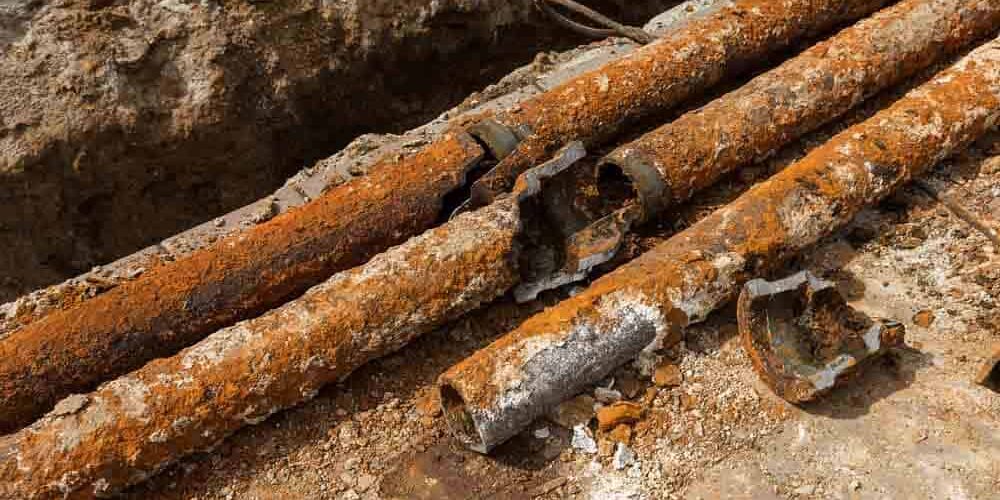
Many older properties exhibit the same frustrating pattern. The drain slows down, the line backs up, someone clears it, and for a while, things seem fine. Then it happens again. At that point, the problem usually is not just “a clog.” In older iron pipes, what is building up inside the line can be far more stubborn than people expect, and treating it the wrong way can do more harm than good. That is what makes the difference between scaling and sludge so important. If you are dealing with aging iron plumbing, understanding that difference can help explain why some cleaning methods work, why others do not, and why older pipes often need a more specialized approach.
What Happens Inside Iron Pipes Over Time
Cast iron pipes corrode from the inside out over decades, creating conditions that standard drain cleaning cannot reverse because the pipe surface itself has changed.
Cast iron was the standard material for drain and sewer lines in homes built before the 1980s. Birmingham has a significant older housing stock, and many of those homes still have original iron drain lines in service. When these pipes were new, the interior was smooth. Water and waste flowed through without catching.
Over time, internal corrosion changes the surface completely. The iron reacts with water, waste gases, and the sulfuric acid naturally produced by sewage. The interior walls pit, flake, and roughen. What was once a smooth channel becomes an uneven surface full of ridges and corrosion.
Two distinct problems develop on that corroded surface: scaling and sludge. Both narrow the pipe. Both cause recurring slow drains. But they behave differently and require different cleaning approaches.
Scaling vs. Sludge: Two Different Problems, Two Different Fixes
Scaling and sludge are often treated as the same blockage, but they form differently, respond to different cleaning methods, and create different long-term risks.
1. Scaling (Hard Buildup)
Scaling is the hard layer. Mineral deposits, calcium, and corrosion byproducts bond to the pipe wall and harden over time.
Scale does not dissolve with chemical cleaners. A standard snake can scrape through it, but the layer remains. Over the years, scaling narrows the pipe diameter permanently.
Water still flows, but the margin for error shrinks. A small amount of debris that would pass through a healthy pipe now catches on the scale and creates a blockage.
2. Sludge (Soft Buildup)
Sludge is the soft layer. Grease, soap residue, organic waste, and biofilm cling to the roughened interior of the corroded pipe.
Sludge is easier to clear than scale, but it returns faster. In a smooth PVC pipe, sludge has little to grip. In a corroded iron pipe, the pitted surface gives it exactly what it needs to reform within weeks.
3. Why the Distinction Matters
A method that dissolves sludge may not touch the scale. A method that clears scale may not address the sludge sitting underneath.
When both are present, which is common in older iron systems, treating them as one problem is exactly why standard drain cleaning keeps failing.
Why Standard Drain Cleaning Falls Short on Iron Pipes
The tools and methods that work well on modern pipes are not designed for the corroded, narrowed, roughened interior of aging cast iron drain lines.
- Chemical cleaners:
Many commercial drain cleaners contain sulfuric acid, which accelerates corrosion in iron pipes. They may dissolve a soft blockage temporarily, but each application weakens the pipe wall further.
- Basic snaking:
Opens a path through the blockage but does not remove the scale or sludge layer from the pipe walls. The narrowed diameter remains, and debris catches again quickly.
- The real issue:
The clog returns not because the cleaning failed, but because the pipe surface is the problem. Until that surface is addressed, any clearing is temporary.
The cleaning method has to match the pipe condition, not just the blockage.
What Specialized Drain Cleaning Looks Like for Iron Pipes
Specialized cleaning for iron pipes starts with a drain inspection to assess what kind of buildup is present and how much pipe integrity remains before choosing a method.
- Drain inspection comes first. A camera inspection reveals whether the issue is scaling, sludge, structural damage, or a combination. It also shows how much wall thickness remains.
This step matters because the wrong cleaning method on a weakened pipe can cause more damage than the buildup it was meant to remove.
- Hydro-jetting for sludge removal. High-pressure water removes sludge and organic buildup from the pipe walls, restoring the line’s full diameter. It is highly effective on soft buildup, but it must be used carefully on corroded iron. If the pipe walls are significantly thinned, the pressure can worsen cracks or blow through weakened sections. That is why inspection comes first.
- Mechanical descaling for hardened buildup. Specialized cutting heads or chain-knocker tools physically break scale off the pipe interior. This is not a standard drain cleaning tool.
It is specific to iron pipe conditions where mineral and corrosion deposits have hardened beyond what water pressure alone can remove.
- When cleaning reveals a deeper problem. Sometimes the inspection shows that the pipe walls are too thin, cracked, or partially collapsed. In those cases, cleaning alone will not solve the issue.
The conversation shifts to drain repair, whether that means trenchless pipe lining to reinforce the existing line or section replacement where the damage is too far gone.
How Birmingham’s Conditions Accelerate Iron Pipe Deterioration
Birmingham’s clay soil, mature tree canopy, and seasonal moisture cycles create conditions that put additional stress on aging iron drain and sewer lines.
Clay soil expands when it absorbs moisture and contracts when it dries. That seasonal movement shifts the ground around your pipes, opening joints and creating stress points where corrosion concentrates. Birmingham’s older neighborhoods sit on exactly this kind of soil.
Mature trees are everywhere in Birmingham’s established communities. Roots naturally seek moisture, and a corroded iron pipe with even a small crack or loose joint is an open invitation. Once roots enter, they grow and catch waste, compounding the blockage on top of the scaling and sludge that is already there.
Heavy seasonal rainfall adds external water pressure around the pipe; at the same time, internal corrosion is weakening it from within. These forces work together, which is why iron pipes in Birmingham often show damage earlier than their expected lifespan would suggest.
If your home is in an older Birmingham neighborhood and your drains keep slowing down despite repeated clearing, the pipe material and the ground it sits in are likely both contributing.
Start With What the Camera Shows
A drain that keeps clogging in an older home is not always a cleaning problem. When the pipe itself has corroded, scaled, or roughened from decades of use, standard clearing is working against a surface that rebuilds the blockage faster than you can remove it.
The first step is not another cleaning. It is finding out what the inside of the pipe actually looks like, so the right method can be matched to the right condition.
A drain inspection shows whether you are dealing with sludge, scale, structural damage, or a combination. That clarity is what separates a temporary fix from one that holds.
Birmingham Drain Cleaning and Sewer Repair runs camera-assisted drain inspections and specialized cleaning for older iron pipe systems across Birmingham. If your drains keep slowing down despite being cleared, schedule a drain inspection and find out what is actually happening inside the line.